For anyone running nginxA fast, free web server and reverse proxy. Read more → on a VPS, in DockerA platform that packages applications into containers, providing a standardized way to build, ship, and run software consistently across any environment. Read more →, or inside Nginx Proxy Manager. We ran the checks below on Debian’s nginx package in our lab. We did not run any exploit.
The short version
In a lot of self-hosted setups, nginx is the front door to everything behind it. On Nov 18, 2026, nginx.org shipped 1.31.9 (mainline) and 1.30.7 (stable) with fixes for two HTTP/2 bugs. CVEA standardized identifier for publicly known cybersecurity vulnerabilities, enabling organizations to track and prioritize security patches. Read more →-2026-123007 is memory corruption in HTTP/2 flow control. CVE-2026-123633 is a use-after-free in HTTP/2. If a server is unpatched and has HTTP/2 on, someone with no login can crash its worker process. Wiz, Xint and Rapid7 showed code execution on 64-bit Linux over TLSThe encryption protocols that secure data in transit between a client and server, powering HTTPS and most encrypted internet communication. Read more →.
F5, which owns nginx and issued the CVEs, rates both 9.2 Critical under CVSS 4.0 and 8.1 High under CVSS 3.1 in the CVE records. nginx.org’s own labels are “major” for 123007 and “medium” for 123633. NVD has not published its own score yet.
We checked CISA’s KEV JSONA lightweight, human-readable data format used to exchange structured information between systems, based on JavaScript object syntax. Read more → at 5:47 AM ET on Mon Nov 23, and neither CVE was listed. CERT-EU, Cloudflare, Qualys and Check Point report no confirmed attacks.
Your first step: run the grep in step 1 to see whether HTTP/2 is on.
Am I exposed? Check in this order
1. Is HTTP/2 on?
Both bugs need HTTP/2. nginx turns it on with http2 on; (1.25.1 and later) or the older listen 443 ssl http2; form. It stays off unless someone turns it on. On our Debian 13 box, a fresh install had no HTTP/2 lines at all. Plenty of guides add it, and Nginx Proxy Manager has a per-host HTTP/2 Support switch. This grep, from Xint’s write-up, searches the full loaded config for both forms:
sudo nginx -T 2>&1 | sed 's/#.*//' | grep -nE 'listen[[:space:]].*http2|^[[:space:]]*http2[[:space:]]+on[[:space:]]*;'No output means no HTTP/2 directives. Confirm it from another network with openssl s_client -connect HOST:443 -servername HOST -alpn h2 </dev/null 2>&1 | grep ALPN. If it prints ALPN protocol: h2, HTTP/2 answers. Behind a CDNA globally distributed network of servers that caches and delivers content from the location closest to each user, reducing latency and origin load. Read more →, test the origin too.
123007 needs nothing more than HTTP/2. Wiz got code execution on a server that only served static files. 123633 also needs nginx to proxy requests to a backend, which every reverse proxy does, and it fires when the worker runs low on worker_connections.
2. Which version and which package?
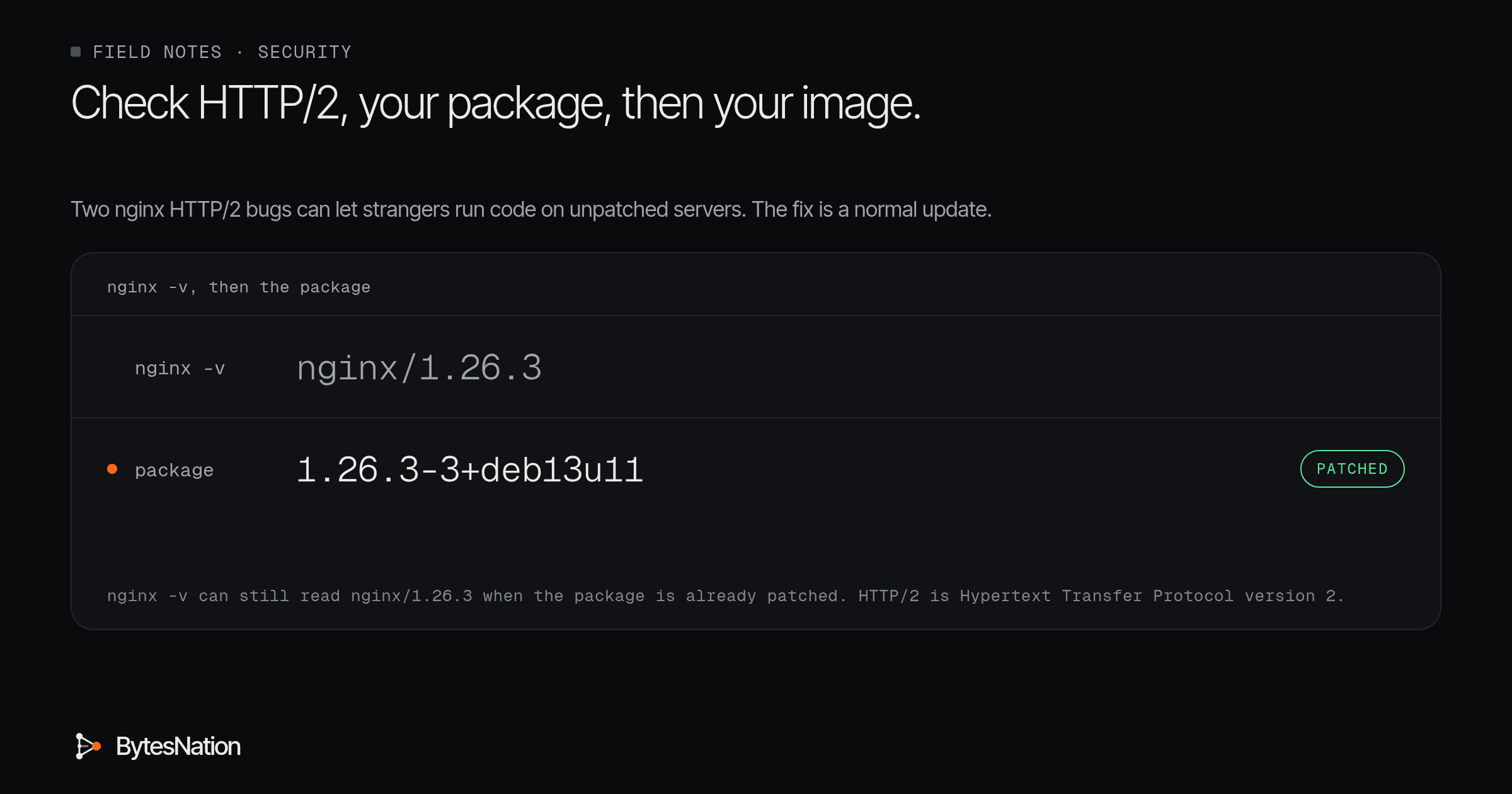
nginx.org lists 123007 as affecting 1.9.5 through 1.31.8, and 123633 as 1.19.7 through 1.31.8. On a distro build, nginx -v can’t settle it. Distros backport, copying the fix into the old version, so only the package version changes. Our box:
$ nginx -v
nginx version: nginx/1.26.3
$ dpkg-query -W -f='${Package} ${Version}\n' nginx nginx-common
nginx 1.26.3-3+deb13u11
nginx-common 1.26.3-3+deb13u11
1.26.3 sits inside both ranges, and this box is still patched. The Debian tracker marks 1.26.3-3+deb13u11 fixed (DSA-6642-1), and apt changelog nginx lists both CVE patches. Trust the package version. On RHEL, Alma and Rocky, run rpm -q nginx. On Alpine, run apk list -I nginx. Compare what you get with the table under Go deeper.
3. Which image or build?
- Official Docker image.
docker exec <container> nginx -vshould say 1.31.9 or 1.30.7. On Docker Hub,latest,mainlineand1.31.9are the same image, andstableis 1.30.7. If you pinned1.31.8,1.30.6or older, change the tag and recreate the containerA lightweight, portable package that bundles an application with its dependencies and runs in an isolated process on the host OS, sharing the kernel. Read more →. A pull alone doesn’t replace a running one. - Nginx Proxy Manager. Version 2.17.1 backports both HTTP/2 fixes, but
nginx -vinside still saysopenresty/1.31.8.1. Ignore that and check the image tag withdocker ps --format '{{.Names}} {{.Image}}'. You want 2.17.1 or later. 2.17.0 and older are affected. - OpenResty. We treat it as exposed. openresty.org still lists 1.31.8.1 as current, tracking issue #1166 is open, and a 1.31.9.1 download has no announcement. Turn HTTP/2 off until a fixed release is announced.
- Angie. Fixed in 1.12.5.
The fix
Update the way you installed it, with apt, dnf, apk, nginx.org’s repo or a new image tag. Restart and run steps 2 and 3 again.
If you can’t patch today
F5’s CVE records list the workaround as “None.” Wiz, Xint and CERT-EU recommend turning HTTP/2 off as a stopgap. On 1.25.1 and later, put http2 off; in every affected server block and remove http2 from listen lines. On older versions, remove it from listen lines. Run nginx -t, reload, and restart if ps keeps showing worker process is shutting down. Clients fall back to HTTP/1.1, and Xint notes that native gRPC breaks.
One catch. Every server block on the same IP and port has to drop HTTP/2. NPM users found in issue #6057 that a single host left on kept h2 answering on the shared 443 listener. Run the ALPN test again after the change.
The stopgap covers only these two bugs. The release fixes others too, so patch anyway, then turn HTTP/2 back on.
Don’t run exploit repos
Rapid7 published a proof of concept for 123007 that needs about 128 GB of HTTP/2 data on one connection. Cloudflare reports fake “exploit” repos circulating on GitHub. Don’t run any of them. The checks above answer the question safely.
Why this got a Tuesday slot
Xint counted 56.7 million hosts reporting nginx on Shodan on Nov 10. The attacker needs no login, and the fix is an ordinary update.
Go deeper: fixed packages, extra checks, and what we could not confirm
Fixed packages, checked Mon Nov 23 against each vendor’s tracker:
| Platform | Fixed package |
|---|---|
| Debian 13 trixie | 1.26.3-3+deb13u11 (DSA-6642-1) |
| Debian 12 bookworm | 1.22.1-9+deb12u11 (DLA-4918-1) |
| Debian forky, sid | 1.30.6-4 |
| Ubuntu 26.10 / 26.04 | 1.30.4-7ubuntu1.2 / 1.28.3-2ubuntu1.13 |
| Ubuntu 24.04 / 22.04 | 1.24.0-2ubuntu7.20 / 1.18.0-6ubuntu14.23 |
| Ubuntu 20.04 and older | Ubuntu Pro only, free for personal use |
| RHEL 10 | nginx-2:1.26.3-16.el10_3.3 (RHSA-2026:100744) |
| RHEL 9 | nginx-2:1.20.1-32.el9_9.2 (RHSA-2026:100748), plus the nginx:1.24 and nginx:1.26 streams |
| RHEL 8 | nginx:1.24 stream (RHSA-2026:100747) |
| Alpine 3.24, edge | 1.30.7-r0 |
| Alpine 3.22, 3.23 | 1.28.3-r8 |
| Alpine 3.21 | 1.26.3-r4 |
| nginx.org repo | 1.30.7-1, 1.31.9-1 |
AlmaLinux and Rocky have matching errata. Sources are Ubuntu, Red Hat and Alpine’s secdb.
More checks. On RPM systems, rpm -q --changelog nginx | grep -E 'CVE-2026-12(3007|3633)' shows whether the fix is in. To see whether the HTTP/2 module is compiled in, run nginx -V 2>&1 | grep -- --with-http_v2_module. On Debian it is, so one http2 on; line is all it takes. Ubuntu notes that on 22.04 and older, a cleartext listen ... http2 listener can also reach the 123633 code path, and its fixed packages close that.
How they work. HTTP/2 flow control counts how many more bytes each side may send. In 123007 that count passes its limit and wraps around. F5 says code execution needs ASLR disabled or bypassed, and Wiz and Xint bypassed it by leaking memory first. In 123633, an HTTP/2 connection with active streams could land on nginx’s list of connections to close and get freed while still in use.
Signs to look for, per Wiz and CERT-EU: worker crashes (exited on signal in error.log), core dumps, and any program the nginx worker user starts. These are weak signals. Check Point says WAF rules and access logs don’t see the HTTP/2 frames involved.
Not confirmed: what else NPM 2.17.1 fixes beyond the two HTTP/2 bugs, Rocky 9’s advisory for the nginx:1.24 stream, RHEL 8 streams other than 1.24, and whether OpenResty 1.31.9.1 is a real release. Our box runs Debian, so we did not test the RPM, Alpine or Docker commands.