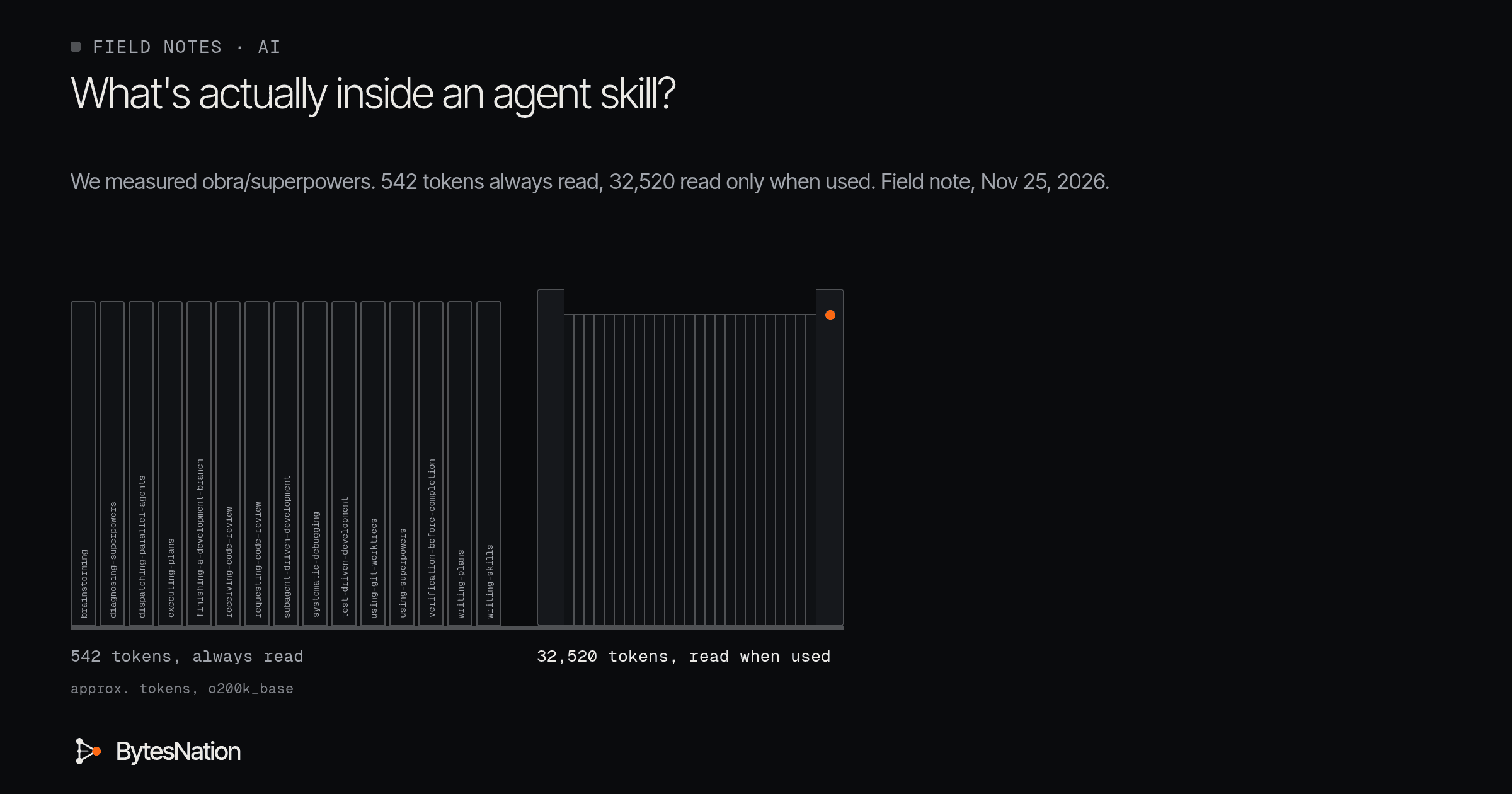
A field note for anyone using an AI coding helper who keeps seeing “skills” on GitHub. Every number below came from our build box this morning, Wed Nov 25, 2026. Nothing here costs money.
The short version
obra/superpowers sat on GitHub’s daily trending page this morning with 1,003 new stars in a day. Its README calls it “a complete software development methodology for your coding agents, built on top of a set of composable skills.” Open it up and the skills are plain MarkdownA lightweight way to format plain text with simple symbols, such as # for headings and * for lists, that converts cleanly into web pages and documents. Read more → files. You can read every one of them over coffee.
We counted them. The 15 skills in the repo carry 542 tokens of name and description in total. Their instruction bodies carry 32,520 tokens. That is about 60 times more text sitting behind the labels than on them.
That gap is the whole design. The Agent Skills specification says agents load the name and description of every skill at startup, load the full body only when a skill is activated, and load any extra files only when needed. So two parts of a skill do two different jobs:
- The description decides when the skill fires. The agent reads it all the time.
- The body is what you pay for when it fires. Once loaded, it is part of what the model reads on later steps.
If a skill misbehaves, one of those two parts is almost always the reason.
Five words you need
- Agent. An AI tool that takes steps on its own toward a goal: reads files, runs commands, edits code.
- Skill. A folder with a file called SKILL.md in it, holding instructions, plus optional scripts or reference files.
- Frontmatter. The few lines between two
---marks at the top of SKILL.md. They hold the skill’s name and description. - TokenThe smallest unit of text that a language model processes, typically a word, part of a word, or a punctuation mark. Read more →. The chunk of text a model counts and bills by. In English it works out to roughly three quarters of a word.
- Context. Everything the model is reading on a given step.
Think of skills as binders on a shelf. The agent reads every spine label all day. It pulls a binder down only when the label matches the job in front of it. A vague label means the wrong binder comes down, or the right one never does. A fat binder costs reading time every time it’s opened.
What we measured
We cloned the repo at commit 22f0b46 (Nov 3, 2026) and counted words and tokens in each SKILL.md with tiktoken 0.14.0, OpenAI’s open source tokenizer, using its o200k_base encoding. Treat the token counts as approximate. Every model family splits text its own way, so Claude or Gemini will count a little differently. The ratios hold.
Three skills tell most of the story:
- verification-before-completion. 47 tokens of frontmatter, 542 words of body, 805 tokens. Short and focused.
- brainstorming. 49 tokens of frontmatter, 2,620 words of body, 3,443 tokens.
- subagent-driven-development. The biggest body at 4,455 tokens, and the shortest label: its description is 12 tokens. It also ships extra files that add up to 11,313 more tokens, which load only when the skill asks for them.
Every body in the repo stays under the spec’s recommended limit of 5,000 tokens. The authors kept big material in separate files, so it costs nothing until a step actually needs it.
Then we wrote a skill of our own, a restore drill that ties back to yesterday’s restic note. Here is the top of it:
---
name: restore-drill
description: Use when the user asks to test, verify or practice restoring a backup, or asks whether a restic backup actually works. Runs a throwaway restore drill and reports the exact restic messages.
---
The body is six numbered rules: restore to /tmp, run restic ls latest first, compare the restored file, treat “Restored 0 files” as a failure, run a full read check, report exact output. It measured 39 tokens of description and 148 tokens of body. A skill does not need to be long to be useful.
One thing we did not do: run a paid agent to watch these skills load. So this note shows what’s in the files and what the spec says happens to them, not a live trace.
Read the descriptions like a router
Since the description is what the agent matches against, it is worth reading two side by side. Here is brainstorming’s, word for word:
“You MUST use this before any creative work - creating features, building components, adding functionality, modifying behavior, or planning anything new, in software or out of it (a talk, a business, a renovation).”
That is deliberately broad and forceful. The author wants it to fire often. And here is subagent-driven-development’s:
“Use when executing implementation plans with independent tasks in the current session”
That one is narrow. It fires only when the task really looks like that. Neither is wrong. They were tuned for different jobs, and the wording is the tuning knob.
Claude Code’s skills docs say the same thing in plain terms: “The description helps Claude decide when to load the skill automatically.” The same page says a skill’s body “loads only when it’s used, so long reference material costs almost nothing until you need it.”
Why body size still matters
“Only when used” does not mean free. Our Nov 18 note showed that a coding agent re-sends its conversation on every step. A body that loads on step 3 rides along on every step after it. Do the arithmetic for the biggest body here: 4,455 tokens, loaded on step 3 of a 30-step task, gets read 28 more times. That is about 125,000 tokens of input from one skill. That figure is a calculation, not a measured bill, and prompt cachingStoring frequently accessed data in a fast, temporary location so future requests can be served without repeating the original expensive operation. Read more → can cut what you pay for repeats. The reading still happens.
There is a second cost that does not show on a bill. Long instructions are harder to follow. A step buried at line 300 is easier to skip than a step in a six-line list.
When your agent ignores a skill
Check in this order, because each check is cheaper than the next:
- The description. Does it use the words you actually type? If you say “restore test” and the description only says “disaster recoveryA plan and set of procedures for restoring IT systems and data after a catastrophic event like a hardware failure, cyberattack, or natural disaster. Read more → validation”, it may never match. Claude Code’s troubleshooting section starts here too.
- The install path. Is the folder where this agent looks for skills? If it never loaded, no wording will help. Each agent documents its own path. Don’t assume one agent’s layout works for another.
- The body. Did it load but skip the step you care about? Move that step near the top, shorten the rest, or push reference material into a separate file.
Your first step
Clone the repo and read one short skill top to bottom, description first:
git clone https://github.com/obra/superpowers
less superpowers/skills/verification-before-completion/SKILL.md
Then ask two questions. Would the description match how you phrase that kind of task? Could you cut the body in half without losing a rule? When you can answer both, write one small skill for a job you repeat every week. Skills are instructions your agent will act on, so read any third-party skill all the way through before you install it, the same way you’d read a script before running it with sudoA Linux command that runs a single command with administrator (root) privileges, after checking that your account is allowed to do so. Read more →.
Go deeper: the full table, our skill and the measuring script
Full measurements, Wed Nov 25, 2026, about 5:42 AM ET by BytesNation Research, re-run 7:26 AM ET. obra/superpowers commit 22f0b463e7a5e579904dd6211a520321035526f7, tiktoken 0.14.0, o200k_base. “Frontmatter tokens” counts the whole block, name plus description. “Other files” counts extra entries in the skill folder.
skill | body_words | body_tokens | frontmatter_tokens | other_files
subagent-driven-development | 2878 | 4455 | 21 | 5
executing-plans | 2953 | 4282 | 38 | 1
writing-skills | 2390 | 3625 | 24 | 2
brainstorming | 2620 | 3443 | 49 | 3
test-driven-development | 1459 | 2317 | 21 | 1
writing-plans | 1619 | 2286 | 25 | 0
systematic-debugging | 1436 | 2177 | 24 | 5
finishing-a-development-branch | 1246 | 1894 | 30 | 0
using-git-worktrees | 1035 | 1581 | 40 | 0
diagnosing-superpowers | 997 | 1546 | 95 | 3
receiving-code-review | 879 | 1416 | 41 | 0
dispatching-parallel-agents | 843 | 1331 | 30 | 0
verification-before-completion | 542 | 805 | 47 | 0
using-superpowers | 465 | 701 | 32 | 1
requesting-code-review | 405 | 661 | 25 | 1
TOTAL skills 15 frontmatter tokens 542 body tokens 32520
Bundled files loaded only on demand: systematic-debugging 4,803 tokens, subagent-driven-development 11,313 tokens.
Our restore-drill skill: frontmatter 47 tokens, description 39 tokens, body 98 words, 148 tokens.
Why o200k_base. It is a free, open encoding we can run offline. Anthropic and Google use their own tokenizers, so their counts will differ somewhat. Use these numbers to compare skills with each other, not to predict an exact bill.
Spec limits worth knowing (Agent Skills specification): description is required and capped at 1,024 characters. Keep SKILL.md under 500 lines. Keep file references one level deep from SKILL.md.
The files. restore-drill/SKILL.md and measure-one.py ship with this note. Run the script on any SKILL.md with tiktoken installed: python measure-one.py path/to/SKILL.md. It prints frontmatter, description and body sizes.
Read before you install. Read the description and ask when it will fire. Read the body for any command that deletes, pushes or sends. Open every bundled script. Check the license. superpowers is MIT licensed.
Scripts
src/restore-drill/SKILL.md
---
name: restore-drill
description: Use when the user asks to test, verify or practice restoring a backup, or asks whether a restic backup actually works. Runs a throwaway restore drill and reports the exact restic messages.
---

# Restore drill

1. Never restore over the live path. Restore to a new folder under /tmp.
2. Run `restic snapshots` and `restic ls latest` first. Use a path that ls shows.
3. Restore one file, then compare it with the original using `cmp`.
4. Read the restore summary line. "Restored 0 files" is a failure even if the exit code is 0.
5. Run `restic check --read-data` on a local repo, or `--read-data-subset=5%` on a remote one.
6. Report each command, its exact output and its exit code. Do not say "it works" without the cmp result.
src/measure-one.py
import os,re,sys,tiktoken
enc=tiktoken.get_encoding("o200k_base")
def measure(p):
  s=open(p,encoding="utf-8").read()
  m=re.match(r"^---\n(.*?)\n---\n(.*)$",s,re.S)
  fm,body=m.group(1),m.group(2)
  d=re.search(r"^description:\s*(.*)$",fm,re.M).group(1)
  return len(enc.encode(fm)),len(enc.encode(d)),len(body.split()),len(enc.encode(body))
for p in sys.argv[1:]:
  ft,dt,bw,bt=measure(p); print(f"{p} | frontmatter_tokens {ft} | description_tokens {dt} | body_words {bw} | body_tokens {bt}")
src/measure-all.py
import os,re,sys,tiktoken
enc=tiktoken.get_encoding("o200k_base")
rows=[];fm_total=0;body_total=0
for root,_,files in os.walk("superpowers"):
  for f in files:
    if f=="SKILL.md":
      p=os.path.join(root,f); s=open(p,encoding="utf-8").read()
      m=re.match(r"^---\n(.*?)\n---\n(.*)$",s,re.S)
      fm,body=(m.group(1),m.group(2)) if m else ("",s)
      desc=re.search(r"^description:\s*(.*)$",fm,re.M)
      ft=len(enc.encode(fm)); bt=len(enc.encode(body)); fm_total+=ft; body_total+=bt
      extra=[x for x in os.listdir(root) if x!="SKILL.md"]
      rows.append((bt,os.path.relpath(root,"superpowers"),len(body.split()),ft,len(extra)))
rows.sort(reverse=True)
print("skill | body_words | body_tokens | frontmatter_tokens | other_files")
for bt,n,w,ft,e in rows: print(f"{n} | {w} | {bt} | {ft} | {e}")
print("TOTAL skills",len(rows),"frontmatter tokens",fm_total,"body tokens",body_total)
for steps in (10,30): print(f"if every body were loaded and re-sent for {steps} steps: {body_total*steps} tokens; frontmatter only: {fm_total*steps}")
src/run-2026-11-25.txt
Wed Nov 25 07:27:17 EST 2026
skill | body_words | body_tokens | frontmatter_tokens | other_files
skills/subagent-driven-development | 2878 | 4455 | 21 | 5
skills/executing-plans | 2953 | 4282 | 38 | 1
skills/writing-skills | 2390 | 3625 | 24 | 2
skills/brainstorming | 2620 | 3443 | 49 | 3
skills/test-driven-development | 1459 | 2317 | 21 | 1
skills/writing-plans | 1619 | 2286 | 25 | 0
skills/systematic-debugging | 1436 | 2177 | 24 | 5
skills/finishing-a-development-branch | 1246 | 1894 | 30 | 0
skills/using-git-worktrees | 1035 | 1581 | 40 | 0
skills/diagnosing-superpowers | 997 | 1546 | 95 | 3
skills/receiving-code-review | 879 | 1416 | 41 | 0
skills/dispatching-parallel-agents | 843 | 1331 | 30 | 0
skills/verification-before-completion | 542 | 805 | 47 | 0
skills/using-superpowers | 465 | 701 | 32 | 1
skills/requesting-code-review | 405 | 661 | 25 | 1
TOTAL skills 15 frontmatter tokens 542 body tokens 32520
if every body were loaded and re-sent for 10 steps: 325200 tokens; frontmatter only: 5420
if every body were loaded and re-sent for 30 steps: 975600 tokens; frontmatter only: 16260
systematic-debugging bundled files tokens (loaded only on demand): 4803
subagent-driven-development bundled files tokens (loaded only on demand): 11313
/workspace/bytesnation/content/articles/2026-11-25-whats-inside-an-agent-skill/src/restore-drill/SKILL.md | frontmatter_tokens 47 | description_tokens 39 | body_words 98 | body_tokens 148